I just finished grading the last of your work, and now I am really sad. No, not because you didn’t do well. You did great, but now our class is officially over and that is kind of a downer. Really, we couldn’t have covered too much more, and it was time to be done, but you were a great class to work with. I will miss our discussions (and Matt complaining about the video clips being too long) and your willingness to try new things and think new ideas. Thank you for your hard work and your excellent products. You are excellent students, all of you!
Good luck with your exams and have a fun, relaxing summer. We will see you back here in September. Before I go, my favorite moments:
Makayla’s dinosaur comment
The Purolator guy and your meme
Your Google Doodles
DJ Tanner and the tour
Tech help from Nicole
Your excellent last project
Matt trying to lawyer answers out of me – smooth, but not that smooth
Anna blocking all of us out with her headphones
AND LAST BUT NOT LEAST (YOU KNEW THIS WAS COMING) ………
Presentation day today, and wow you blew me away with your enthusiasm and great work. It is gratifying to see a group of students produce such excellent results. Hats off to you
Hi group. Yes, I am not there. Convocation day today. The ceremony is at TCU Place. I will let you know how it goes. I posted another field trip photo for you, and the other image is random. It made me laugh, sorry if you think it is a little lame, but it struck me as funny.
Okay….work plan: today is a research day. So, carry on with the work you may or may not have started yesterday. I think that you will need all of the time today to get a good start on that. Remember, in order to do a credible analysis, you need a firm grip on the historical context.
Good luck at provincial track, Nicole. I can’t wait to hear how you do. Tell Sara and Jan good luck from me, too. See the rest of you on Friday.
Greetings. I am away….again. Today, Mrs. Slade and I are at the Division Literacy Fair (remember the big poster I was working on), but you will be in good hands with Mr. K.
So here is today…..
1. Complete your radio news story. Once you are happy with it, make a recording of it. I found a few different web tools you can use to do your recording at http://cooltoolsforschools.wikispaces.com/Audio+Tools. You will have to see which one works the best for you. Remember, you will need to embed it on your blog.
2. Once you get that done up, you can start your research for your accuracy analysis of a historical based film assignment. Please remember you need to discuss three particular aspects, so you will need to do some thorough research on your topic.
3. If the world is working the way it should, you should be able to start your viewings on Tuesday, so let’s plan for that.
Okay…enough of me….get to work and have a good day. By the way, great job of the Prezi presentations yesterday, Matt and Nicole.
Whether by knotted string, smoke signals, a town crier or a rider on horseback, information about people, events, and issues, was received with anticipation throughout the times.
Today’s questions: What is the purpose of journalism? What is news? How is it gathered for airing?
Discussion: How do you get your news?
Activity
1. Review the qualities that makes information news. Let’s give some examples.
2. How is news presented in print journalism. Look at the newspaper on the tables. How did technology play a role in this?
3.
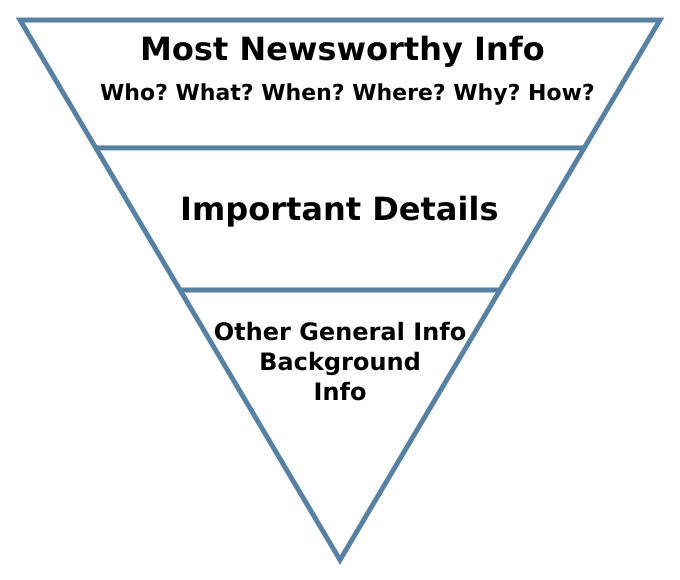
4. What news should be presented in the traditional or hard lede of a newspaper article?
5. How would print lede differ from an radio lede? How do the the aural and time constraints of radio influence the order and information included in the radio news lede?
6. List to the following news spot and record the 5Ws and H that was presented. Share your information with your classmates to see if you are accurate.
FOR MANY CANADIANS over the age of 40, Knowlton Nash will always be their most trusted news anchor. Nash was renowned for his trademark spectacles, graciousness, and intelligence while delivering the news on CBC TV. He died Saturday at the age of 86.
Welcome back from the weekend. I hope you are well rested. In preparation for our field trip on Friday, we will spend time this week looking at the radio and news broadcasting. We’ll start with radio…
Radio brought the world to homes in the 1920s — broadcasting music, sound effects and the spoken word. Housewives during the day and families at night were transported by adventurous tales and heroes, soap operas and comedy, westerns and variety shows, and news from around the globe. Radio became so popular by the late 1930’s, eight of 10 adults owned a set. Below is an example of a radio program that would capture the imagination of listening audiences.
Activity:
1. Describe what you were thinking or visualizing as you listened to the production.
2. What are aspects of the medium that you enjoyed?
3. Were there aspects you didn’t enjoy?
4. Use a Venn diagram to compare and contrast this “program” to a television show you enjoy. Which tells a better story? Explain.
Radio prepared the path for electronic communication. Its technology allowed for the suspension of
reality and infl uence on Canadian culture. What do you know about Guglielmo Marconi or Reginald Fessenden? It may surprise you to learn that although Marconi is “remembered as the inventor of the radio, Fessenden (a Canadian) managed to send a radio signal almost a year earlier, on Dec. 23, 1900, in his lab near Washington, D.C
Today, you are here and I am not. I am away for meetings today, but have some interesting work for you to start. Today you will be tracing the history of cinema. Cinema, or motion picture, is the art of moving images; a visual medium that tells stories and exposes reality. Created in the dusk of the 19th century, cinema is the world’s most recent art form. It is also, by far, the world’s most complex, collaborative, and costly artistic expression. Movies developed gradually from a carnival novelty to one of the most important tools of communication and entertainment, and mass media in the 20th century. Motion picture films have had a substantial impact on the arts, technology, and politics.
Assignment:
1. You will present the history of the motion picture.
2. You will use a prezi format to present your work. For this, go to http://prezi.com/. You are encouraged to embed video/graphics in your prezi to help clarify ideas.
3. Your information must include:
– the birth of film (actual film)
– early stages
– the silent era
– animations
– the feature film era
– film as art
– war and post-war era
– Hollywood influences
– VCR era
– DVD era
– independent films
– documentary films
– long tail
– the film festivals (Cannes, Toronto, etc.)
NOTE: To view the rubric I will be using to evaluate your work, go to > openPublic drive > MEDS Folder> Prezi Rubric. If you have questions, text me. I will reply during my lunch break.
Good luck at Section Track and Field today. Anna and I will hold down the fort while the rest of you are gone. When you get back, I will have our field trip forms ready to go. Remember, you have to decide where we will have lunch.




.jpg)

